


felt basics
Needle-Punch Felt vs Woven Felt
A clear comparison of needle-punch (non-woven) felt and woven felt — how each is made, their properties, and where each is used.
Tulsi Overseas ·
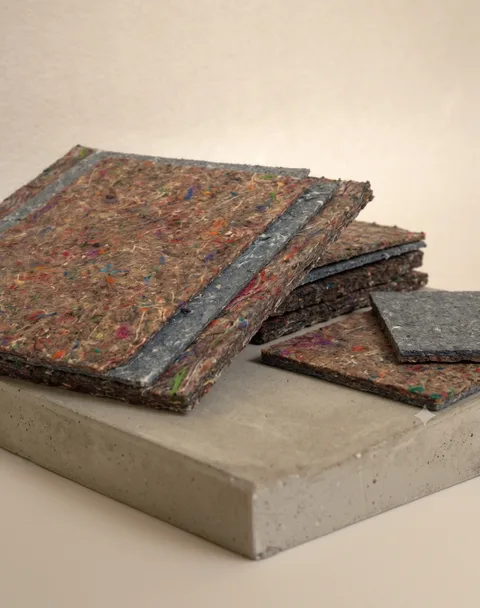
Two ways to make felt
“Felt” covers any fabric made by matting fibres together. The two families you will meet in industry are non-woven (needle-punch) felt and woven felt.
Needle-punch (non-woven) felt
Fibres are opened, blended, layered into a web and then mechanically interlocked by thousands of barbed needles punching through the batt — 600 to 2000 punches per minute. No weaving and no chemical binder is involved. This is the same manufacturing process used for every felt Tulsi Overseas produces, and the result is a dense, uniform fabric that can be made to almost any thickness and density.
Best for: mattress insulating layers, automotive NVH insulation, padding, underlay, packaging.
Woven felt
Woven felt is made on a loom from spun yarns, then often fulled (shrunk and matted). It is more labour-intensive and harder to make very thick.
Best for: specialist sealing, polishing and traditional textile uses.
Quick comparison
| Property | Needle-punch (non-woven) | Woven |
|---|---|---|
| How it’s made | Fibres entangled by barbed needles | Yarns woven on a loom |
| Thickness range | Thin sheet to heavy batt | Limited |
| Strength | Uniform, multi-directional | Directional (warp/weft) |
| Cost | Generally lower | Higher |
| Typical use | Mattress, automotive, insulation | Sealing, polishing |
For mattress, automotive and furnishing applications, needle-punch non-woven felt is almost always the right choice — and it is what Tulsi Overseas manufactures.
Frequently asked questions
- Is needle-punch felt the same as non-woven felt?
- Needle-punch felt is a type of non-woven felt. "Non-woven" means the fabric is made directly from fibres without weaving; needle punching is the specific method that mechanically entangles those fibres with barbed needles.
- Which is stronger, woven or needle-punch felt?
- It depends on direction and use. Woven felt has defined warp/weft strength; needle-punch felt has uniform multi-directional strength and is easier to make thick and dense, which is why it dominates mattress and automotive insulation.