


Manufacturing
From recycled fibre to finished felt
The felt you order and the felt we ship come off the same line, built the same way, every time. This is that line — stage by stage.
Every stage under one roof · Panipat
Your felt, built from scratch.
Every roll that leaves our factory passes through all ten of these stages under one roof — no outsourcing, no shortcuts.
Step 1 of 10
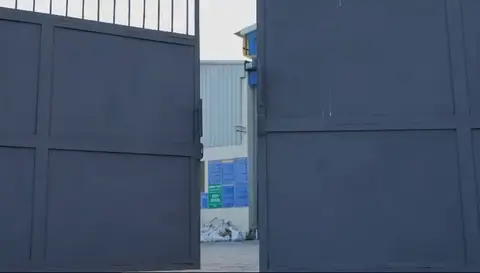
Raw Material
Sorted recycled textile fibre is the starting feedstock — diverting waste from landfill.
Mixed post-industrial textile fibre is sorted and graded, then fed into the line. Using recycled fibre is the foundation of the circular-economy story behind every Tulsi Overseas felt.
Step 2 of 10
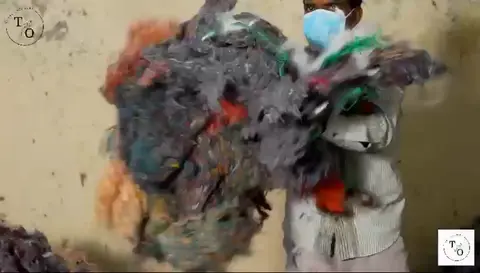
Opener
Compressed fibre is opened up and loosened.
The opener teases the dense, baled fibre apart into a light, airy mass so it can be evenly blended.
Step 3 of 10
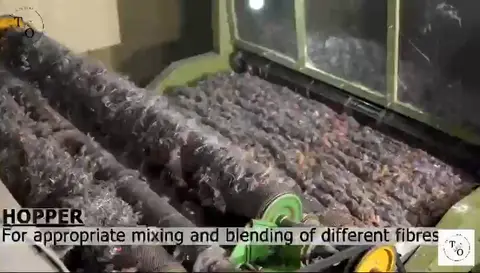
Hopper
The blended fibre is stored and metered into the line.
The hopper buffers and feeds a steady, controlled volume of fibre forward — the key to consistent GSM.
Step 4 of 10
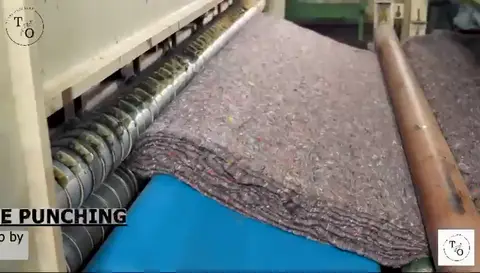
Carding
Combs, disentangles and aligns the fibre into a thin web.
The carding machine combs the fibre into a fine, aligned web — the building block of the felt sheet.
Step 5 of 10
Cross Lapper
Layers the carded web to the target thickness.
The cross lapper folds the thin web back and forth into multiple layers, building the batt up to the required thickness and weight.
Step 6 of 10
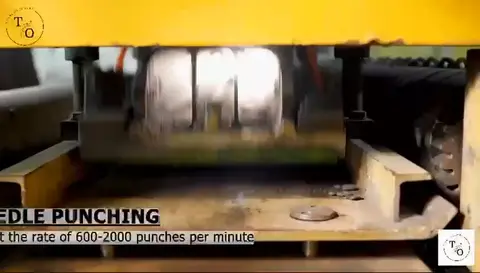
Needle Punching
Barbed needles interlock the fibres — 600–2000 punches per minute.
Thousands of barbed needles punch through the batt 600–2000 times per minute, mechanically entangling the fibres into a strong, cohesive non-woven felt — no chemical binders required.
Step 7 of 10
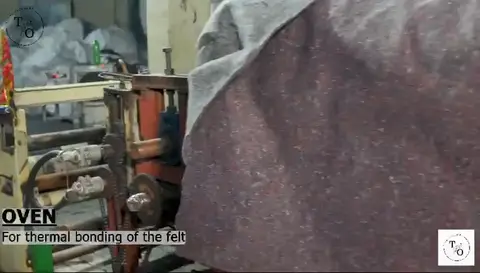
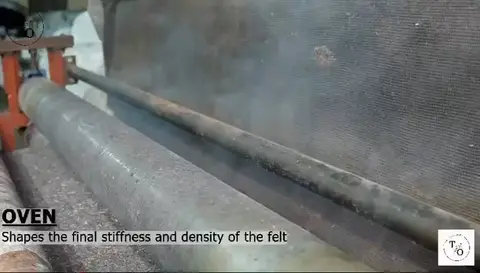
Oven (Thermal Bonding)
Heats the felt above 250 °C to set final stiffness and density.
Thermal bonding in the oven at over 250 °C fuses the structure, fixing the final stiffness, density and dimensional stability of the felt.
Step 8 of 10
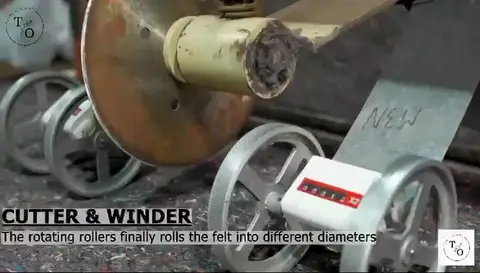
Cutter & Winder
Trims to final width and rolls to the ordered diameter.
Sharp blades trim the edges to the exact width while the winder rolls the felt to the customer's specified roll diameter.
Step 9 of 10
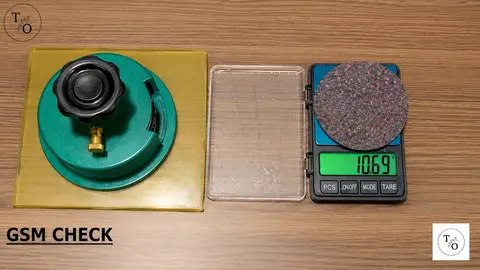
GSM Check
Every roll is weighed and checked against the ordered GSM before it's cleared to pack.
A sample is drawn from the finished roll and checked against the ordered GSM and tolerance — the last checkpoint before a roll is cleared for packing, so drift never reaches a shipment.
Step 10 of 10
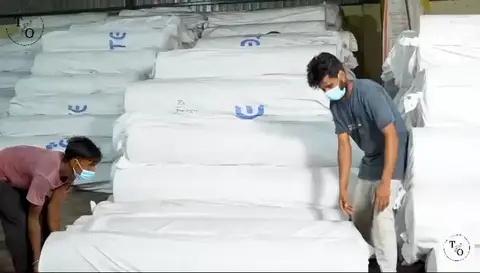
Weighing & Packing
Rolls are weighed, packed and palletised for dispatch.
Finished rolls and sheets are weighed, wrapped and palletised — ready for domestic delivery or export.
Frequently asked questions
- How is non-woven felt made?
- Non-woven felt is made by opening recycled fibre, carding it into a web, layering the web with a cross-lapper, then needle-punching it 600–2000 times per minute to interlock the fibres. It is finally thermally bonded in an oven above 250 °C, checked against the ordered GSM, and trimmed and rolled to size.
- Does the felt use chemical binders?
- No. The fibres are bonded mechanically by needle punching and then heat-set, so no chemical binders are required.
- What temperature is used to bond the felt?
- After needle punching, the felt passes through an oven at over 250 °C, which sets its final stiffness, density and dimensional stability.
Get in touch
Want felt made on this line?
Tell us your specification and we'll quote you directly.